

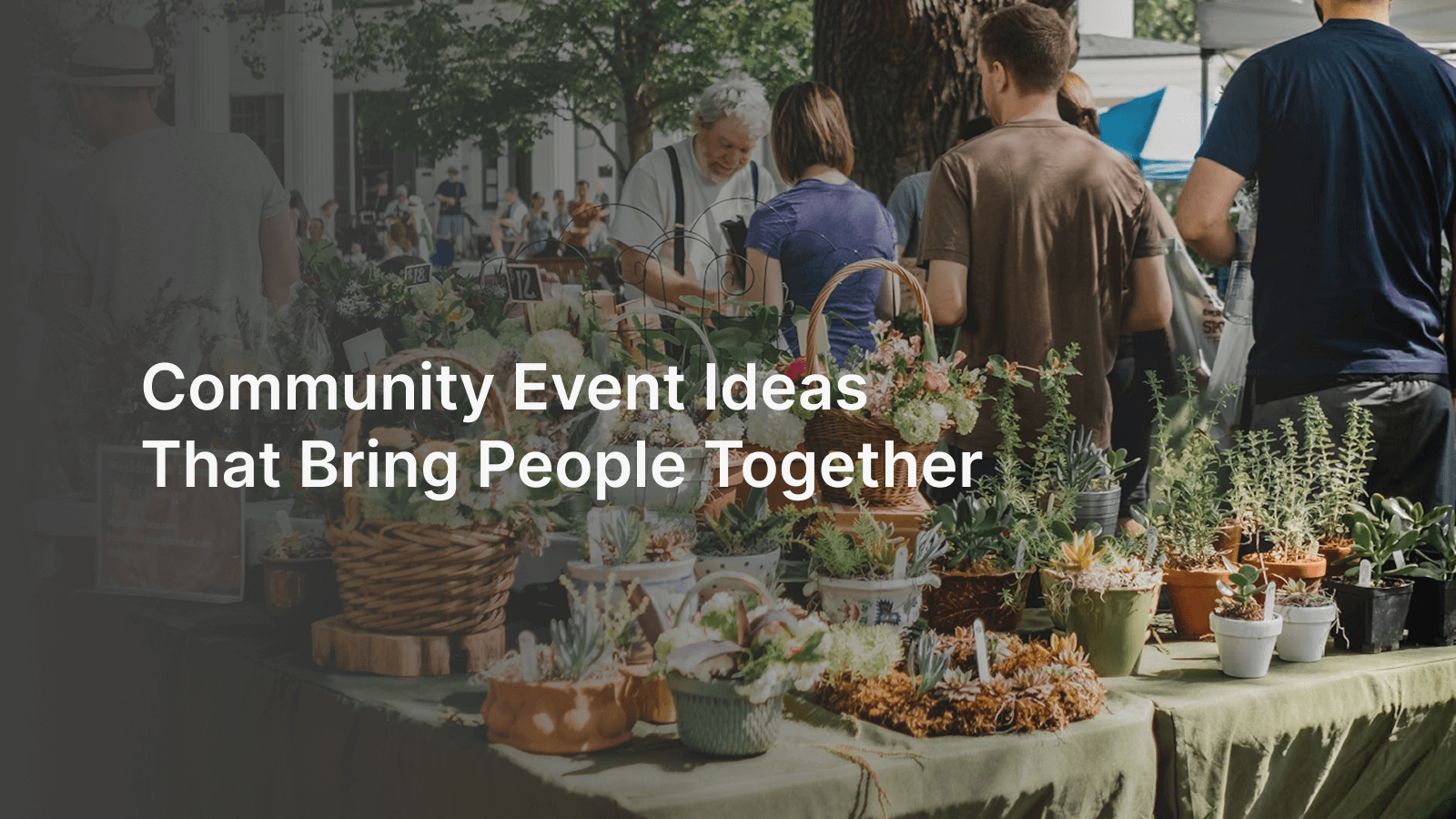
In a world that feels increasingly digital, in-person connection has never been more valuable.
Community events turn neighbours into friends, and strangers into collaborators.
Whether you’re planning something small, like a park cleanup; or ambitious, like a local festival, these 20 ideas will help inspire you to come up with the perfect event for your local community.
1. Neighbourhood Potluck
People can sign up and bring a dish to the neighbourhood potluck. Food breaks barriers, and potlucks give everyone a reason to show up and share.
Resources required: Tables, chairs, sign-up sheet for dishes, cutlery, plates, cups, napkins, simple decorations, and waste bins.
Variations on the idea: Smaller: A catered dinner. Instead of asking people to bring food which has a large organisational element to it, and requires each participants to prepare something, simply cater dinner for everyone.
Bigger: Invite local restaurants to do a potluck. They each have a table and can prepare anything they like. Attendees pay an entry fee and can try food from any table.
Execution tips: Have a theme for the potluck like “local produce”, “tropical”, “Thanksgiving”, “baked good”. This will help people figure out what to bring and make your potluck more cohesive.
Tell people how much to cook so that you don’t have some people preparing food for 5 people, and others cooking for 50.
You’ll need to curate the overall menu to ensure you don’t have 10 people bringing the same thing!
2. Community Art Walk
Transform local streets and businesses into an open gallery. Artists gain exposure, and the community discovers creativity in everyday spaces.
Resources required: Display spaces, artist coordination, map or guide, permits if public.
Variations on the idea: Smaller: 1 day artist exhibition in a local cafe
Bigger: Multi-day art fair with art for sale, workshops, food stalls, and live music.
Execution tips: This will require months of planning. Give artists, local businesses and government officials (if relevant) plenty of time to prepare.
Promotion on social media is key. Make content for each artist and their process, each business, and the history of local streets.
3. Park/Beach Clean-Up
Organise a day where the local community heads to the park or beach to pick litter. A park or beach cleanup is a good way to strengthen local pride and help our environment.
Resources required: Trash bags, gloves, sun protection, permits, refreshments.
Variations on the idea: Smaller: Physical posters and social media posts reminding people to pick up trash on their daily commutes.
Bigger: Make it a recurring event. Every month, you clean up a new park or beach area within your city.
Execution tips: Find out in advance where to dispose of the trash you’ve picked. Throwing multiple bags of trash next to an overflowing trash can might do more harm than good.
4. Street Music Festival
Fill your streets with music. Invite local bands, student performers, or open mic acts for a full day of joy and discovery.
Resources required: Sound setup, stage area, lighting, permits, volunteers, food vendors, seating.
Variations on the idea: Smaller: Weekend buskers’ corner. Bigger: Multi-day music festival.
Execution tips: It all starts with the bands. Find 1-2 bands to be the cornerstone of your event, and build everything around them.
5. Book club
Book clubs are a great way to inspire lifelong readers and spark neighbourhood connections.
Resources required: An easily available book to read, a host, refreshments, venue
Variations on the idea: Smaller: an unmanned book swap box at a community centre. Bigger: Multiple book clubs with different themes (crime, non-fiction, fantasy).
Execution tips: Getting a good host is the most important part of the book club. Rotating hosts can lead to varied competency levels and can make the experience hard to predict.
Many people stop attending book clubs because they can’t find the time to read the book. Encourage people to attend and enjoy the conversations even if they haven’t finished reading the book.
6. Coffee & Conversations Morning
There’s nothing simpler than good coffee and better conversations. Create a quiet corner with a table and some chairs for anyone to meet and have a conversation.
Resources required: Venue, coffee/tea supplies, seating, prompts.
Variations on the idea: Smaller: A notebook for anyone to share their thoughts with no judgement. Bigger: Themed versions so that people can get together and talk about their favourite hobbies or interests.
Execution tips: Having conversation cards or prompts are key to getting the conversation going.
7. Plant Swap
Green spaces make happier neighbours. A plant swap celebrates the joy of growing things and helps community members get to know each other.
Resources required: Tables, tents, labels, gloves, signs, pots, soil.
Variations on the idea: Smaller: Invite a local botanist to share gardening tips at a community garden. Bigger: Gardening fair with workshops and gardening vendors.
Execution tips: Some plants might carry diseases or unwanted mites. Have an experienced gardener around to help look out for such issues before any plants are swapped.
8. Fun Run for a Cause
Raise funds and fitness levels at the same time. A local fun run builds spirit and visibility for a great cause.
Resources required: Route plan, volunteers, paramedics, hydration, medals, registration form, permits.
Variations on the idea: Smaller: Community park walk, where anyone can come and walk together for an hour around the park. Bigger: Charity marathon.
Execution tips: Make sure the route is clearly demarcated, you don’t want people getting lost! Volunteers should be well-briefed on what to do in the event of heat exhaustion, dehydration and injury so that no time is wasted in getting people the treatment they need in event of emergency.
9. BBQ Block Party
Grills, music, and laughter. A BBQ party can be heard and smelled from blocks away and bring everyone to the party.
Resources required: BBQs, tables, power, food, music, trash bins, permits.
Variations on the idea: Smaller: Community meet up at a local cafe. Bigger: BBQ food festival
Execution tips: BBQ can be slow to cook. Make sure the vendor is familiar with time issues and has parboiled and pre-prepared everything so that cook times are fast and nobody is kept waiting.
BBQs are messy. Make sure to provide ample trash bins everywhere to make clean up easier.
10. Family Game Night
Table top games can be played by kids, parents and even grandparents. It’s an easy way to turn a quiet evening into laughter and competition.
Resources required: Venue, table top games, and snacks.
Variations on the idea: Smaller: Uno and Jenga night. Instead of having to source and curate multiple games, having 1-2 classics simplifies things considerable. Bigger: Trivia tournament with prizes.
Execution tips: Provide a range of games of varying difficulty and types so that there’s something for everyone.
11. Outdoor Movie Night
Turn a wall or blank building into a big-screen experience for anyone to watch, while enjoying the late night air.
Resources required: Projector, sound system, seating area, power source, permits.
Variations on the idea: Smaller: Movie screening at the community centre multi-purpose hall. Bigger: Park screening with food trucks.
Execution tips: Audio quality can be tricky in open spaces, make sure to rent a high quality sound system for the outdoors and test it thoroughly.
12. Yoga or pilates open mat sessions
Health is more fun together. Sunrise yoga or evening pilates adds energy to shared spaces. All experience levels welcome.
Resources required: Instructor, sound system, mats, shade, venue.
Variations on the idea: Smaller: Unstructured open mat time. No need for instructors. Just some mats for anyone to use. Bigger: Wellness weekends with multiple classes and workshops.
Execution tips: Decide what kind of experience you want for attendees and decide on a location accordingly. A calm, quiet room could be great for a small class looking to relax, while an open park session with kids and families in the background could create a more energetic environment.
13. Community Bake Sale
Wholesome, nostalgic, and effective. Bake sales raise funds and smiles all at once.
Resources required: Tables, baked goods, cash box, signage, volunteers.
Variations on the idea: Smaller: A bake sale but with a single home baker. Bigger: “Bake Auction” with cakes being auctioned off to the highest bidder.
Execution tips: If the cakes are going to be out in the open, make sure there are ways for them to be covered or kept. Especially if you are in a place where weather or bugs are a concern.
14. Open Mic Night
For budding poets, singers and performers to have the stage for the night.
Resources required: Portable stage, lighting, performers, seating, refreshments, and a sound system.
Variations on the idea: Smaller: Invite local buskers to performance for a night. Bigger: A festival celebrating local talent. Invite performers, home bakers and cooks, and more to showcase their talents.
Execution tips: It’s good to set expectations and rules before the night begins. For example: What kind of jokes and stories are acceptable? Should the event be child friendly? What happens if they break the rules?
15. Local Makers Market
Support local artisans and bring shopping back to human scale.
Resources required: Tables, tents, power, signage, rest areas.
Variations on the idea: Smaller: A makers meet up where locals with the same hobby can meet to chat about their shared interests. Bigger: Holiday market with performances and workshops.
Execution tips: Have one or two food and beverage vendors with seating areas so that attendees will stay longer. Also, music will make the whole place feel more lively.
16. eSports Tournament
Engage younger audiences in their favourite sport – esports.
Resources required: Consoles, screens, power, venue, internet, prizes.
Variations on the idea: Smaller: meet up in a gaming cafe. Bigger: Multi-game tournament with sponsors and prize money.
Execution tips: Try to stream the tournament live if you can to reach an even bigger audience online, not just in person.
17. Paws in the Park
Pets make perfect icebreakers. Host a day for animal lovers and their furry friends.
Resources required: Open field, water stations, shade, safety signs, and one or two pet vendors.
Variations on the idea: Smaller: Cat/dog meet up. Bigger: Pet festival with many more vendor stalls.
Execution tips: On top of open fields for open play, consider having smaller sectioned off quiet areas for nervous and anxious pets.
18. Sustainability Fair
Have a weekend fair with vendors and workshops showcasing simple ways to live greener without breaking the bank.
Variations on the idea: Smaller: Sustainability talk by a local environmental activist. Bigger: Sustainability campaign – get your local city council involved in meaningful change in your city to reduce carbon emissions and improve sustainability. Organise a sustainability fair to announce and celebrate the campaign.
Execution ideas: Greenwashing is a common issue for sustainability initiatives. This is when people talk about ideas or sell products that position themselves as environmentally friendly, even though they have little to no impact (or in some cases negative impact) on the environment. Make sure products and workshops are actually good for the planet.
19. Scavenger Hunt
Turn your neighbourhood into a playground of discovery. Participants can play as individuals or in teams and go around the neighbourhood to solve clues and win prizes.
Resources required: Printed clue lists or QR codes, prizes, volunteers.
Variations on the idea: Smaller: A photo hunt. Rather than having to create and hide clues in the neighbourhood, simply create a list of photos for participants to take in order to win. This could be anything from birds to familiar local faces. Bigger: Expand the bounds of the scavenger hunt so that participants have to drive or take the bus in order to solve clues.
Execution tips: Getting the right difficulty levels of clues can be tricky. Too easy, and the hunt is unsatisfying. Too hard, and it becomes frustrating. Prior to the event, do multiple run throughs with friends to test the difficulty level of the clues.
20. Community Dance Night
End your event calendar with joy. A dance night brings young and old onto the floor.
Resources required: DJ or band, lighting, space, refreshments, safety plan.
Variations on the idea: Smaller: Schedule themed music to be played in public areas on certain night. Friday evenings: 80s music. Saturday evenings: 90s music. And so on. Bigger: Dance competition followed by open dance floor.
Execution tips: A good music system is key. But so is adequate ventilation or air conditioning. It’s easy to get hot quickly when dancing up a storm on the dance floor. Also, pay attention to lighting. If it feels like a hospital room, people will feel more self-conscious and less likely too dance. Having slightly dim lightning will encourage people to get on the floor.
How to choose an idea and brainstorm new ones
If you’ve ever been asked to “plan something fun for the community,” you know how quickly the excitement can turn into overwhelm.
Between finding a venue, rallying volunteers, and promoting the event, it’s easy to get stuck on the most basic question of all: What kind of events should we even run?
Don’t worry, you don’t need to be a creative genius to come up with great ideas.
With a few structured prompts, anyone can get inspiration to organise memorable, meaningful gatherings.
Quick! List out some ideas!
Before you get too prescriptive, list out as many ideas as you can manage. If you’re doing this as a group, get everyone to write all their ideas down and pin them up on a board.
Don’t filter or sensor yourself. No idea is a bad idea. The more ideas the better!
Here are some prompts:
What has your community done in the past? What did you like/think could be improved?
Mix and match: Combine interests, themes and ideas to create new ones. “Food festival” + “sustainability” = “sustainable food festival”. “Taylor Swift” + “Dance Night” = “Taylor Swift Dance Night”.
Think in hobbies: Gardening, gaming, knitting, pottery.
Now think in types of events: Concerts, festivals, meet ups.
Next, write down your goals for the event
Here are some prompts to help you come up with your goals:
What am I trying to accomplish?
What outcomes am I trying to create?
Do I want to create new friendships between strangers with shared interests? Or do I want to strengthen family ties through activities?
Are we celebrating heritage and culture? Or building new ideas and infrastructure?
Being clear on the outcomes and goals will help you create an event with a strong purpose.
Who are you trying to support?
Different events draw different demographics. For example, an e-sports tournament is likely to draw youths, while a taichi class is likely to draw the elderly.
Aside from age, there are activities that encourage individuals to go and make new friends, like a 3D printing meet up. There are also activities that encourage families to participate as a team, like a scavenger hunt.
Get clear on your available resources and budget
Do you have a free venue? That’s a big advantage and it might be worth planning an event that can be held there.
Only have $100 budget? Might have to scale down that festival idea into a meet up.
Take some time to think about what free resources or volunteers are available to you and also be honest about the budget you have.
Those are your guardrails for the size of the event you can organise.
Finally, go back to your list of ideas and connect the dots
Go back to your list of ideas. Instead of thinking of them as ideas, think of everything on the page as individual words.
“Sustainable food festival” is actually “sustainability” “food” and “festival”.
Now start circling words that make sense based on your goals, audience and budget.
For example, if you have a small budget, then words like “meet up” or “workshop” might get circled. While words like “festival” or “market” might be avoided.
Similarly, if your audience is “families”, then words like “pets” and “movies” might get circled. While words like “yoga” and “esports” might be avoided.
After you’ve circled the relevant words, it’s time to connect the dots. Perhaps a “pet meet up for families” might be the perfect event for you. Or “Esports expo” is exactly what you’re looking for.
Take some time to think of variations to your best ideas that would fit your criteria as best you can.
Turn Ideas Into Action with EventKoi
Once you have your idea, you’re halfway there.
The next step is to make it real – create an event listing, set dates, and get sign-ups.
That’s where EventKoi helps:
- Quickly create and publish your event (no coding needed)
- Show it beautifully on your website or calendar
- Engage your audience with details, categories, and recurring schedules
Your event deserves more than just a Facebook post.
With EventKoi, you can give it a proper home so that your community can find and share it effortlessly.